

Two weeks ago I was in this article The launch of the "Wiselife" app experiment was announced. What initially seemed quite promising (I must honestly admit that I only became aware of it through an advertisement within another app) already gave me some cause for concern after the first day. And I'll say it right now: these concerns were not unfounded.
Points awarded based on steps or videos.
Just a quick reminder: Wiselife is supposed to be characterized by converting daily steps into points, which can then be converted into real money once a certain threshold is reached. This can be done via PayPal, Amazon vouchers, or directly as credit to a credit card. After the first day, I noticed that while steps were converted into a small number of points, watching short videos was a way to earn (significantly) more points. And this was really lucrative in the first few days. However, I quickly realized there was a pattern to it. While I initially received a good 4,500 points per video, the number of points I could earn decreased day by day. By the second day, I was only receiving 4,200 points. On the third day, only 3,800, and so on.
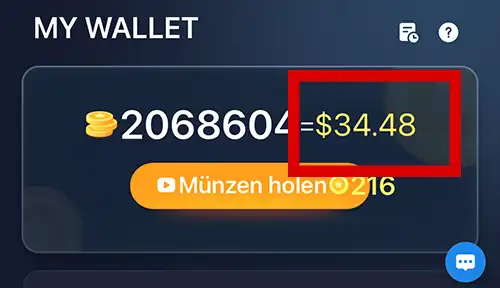
This creates a kind of "compulsion." You want to watch as many videos as possible to grab the bonus of high points. The app's actual purpose—earning points through steps—quickly fades into the background. Additional incentives like a wheel of fortune or a slot machine (which, of course, also require watching advertising videos) are designed to keep users engaged with the app for as long as possible. Let's briefly return to the decreasing points. After 10 days (just before reaching the minimum payout threshold of 2 million points), I was only receiving slightly over 200 points per advertising video. But then… after 11 days, it happened: I crossed the magical 2 million point barrier and was already looking forward to my payout.
The shift between expectation and reality
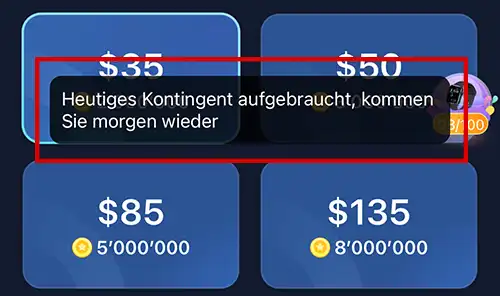
Here too, I must admit that I expected to be slowed down by some specific requirement. Whether it was something like, "You need to recruit 10 more participants before you can withdraw," or the familiar tactic of "90% fees will be deducted from the payout amount." But what I actually experienced was new to me. No matter which payout method I chose—PayPal, credit card, SEPA transfer, Amazon, etc.—after every request, I received the message that... for today The app said the quota was used up and I should come back tomorrow. Okay, I thought – maybe that was really the case. Having used the app over the past few days, I noticed that its system time also reset at exactly midnight. So, the next day at precisely 12:03 a.m., I tried again: with the exact same error message. Even on day three after reaching the limit, the app still gives me the same message when I request a withdrawal.
My conclusion on “Wiselife”
My initial gut feeling was right. In my opinion, Wiselife is a scam app that makes a huge amount of money by forcing users to watch ads, but doesn't pay out any of it to their users. I feel like I watched about 350 ads in 11 days, which the app provider obviously charged for. I will try contacting the developers by email, but I don't have much hope. The interesting thing is that Apple itself approved the app in their store. I'll report that too, so you can be protected from such dubious providers in the future.